

Anyone comparing clinics abroad eventually asks the same question: is Brazil safe for dental implants? It is a fair thing to ask before booking flights and committing to a treatment plan. This guide covers what actually determines safety, how Brazilian dentistry is regulated, and what to check before you travel.
Quick answer: Brazil is a safe destination for implant treatment when the work is done by a dentist registered with the regional council and the case is properly diagnosed beforehand. Brazilian implant dentistry follows the same evidence base and the same clinical protocols used in Europe and North America.
What makes implant treatment safe, anywhere
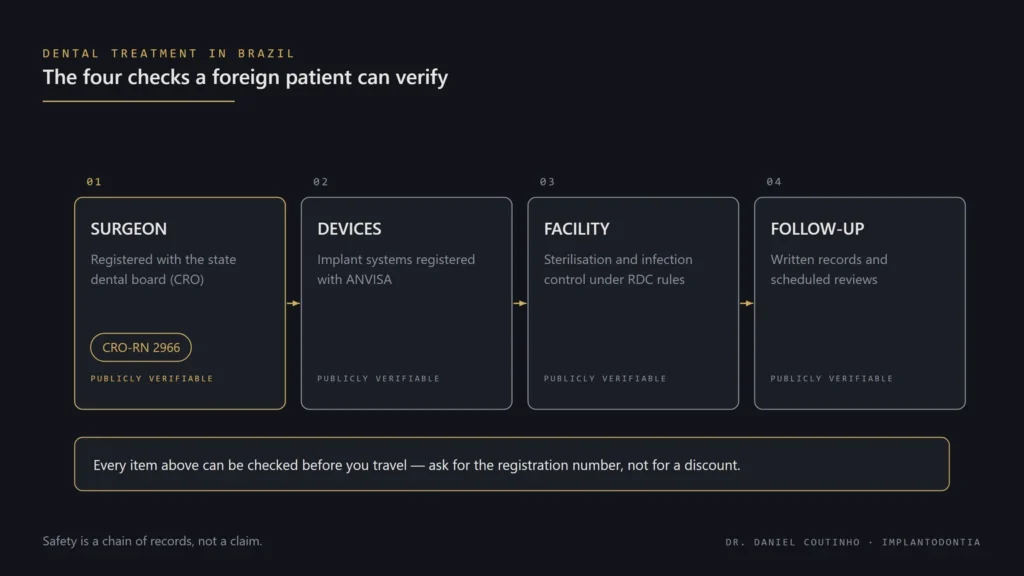
Safety in implant dentistry is not a property of a country. It comes from four things: the quality of the diagnosis, the training of the person operating, the sterilisation and surgical protocol, and honest case selection — the willingness to say that a case is not suitable, or that a different approach is needed first. Anyone asking “is Brazil safe for dental implants?” is really asking about those four things.
That last point is the one patients rarely think to look for, and it is the most revealing. A clinic that accepts every case without conditions is not being accommodating; it is skipping the step where risk gets identified.
How dentistry is regulated in Brazil
Dentistry in Brazil is regulated federally by the Conselho Federal de Odontologia and, at state level, by the regional councils. Practising without registration is illegal, and the registration is public.
What the CRO number tells you
Every licensed dentist has a CRO number tied to the state where they practise. Dr. Daniel Coutinho is registered as CRO-RN 2966, in Natal, state of Rio Grande do Norte. The number can be checked against the council register, and any clinic should give it to you in writing without hesitation. A refusal, or a vague answer, is itself the answer.
Questions worth asking before you travel
- Who will actually perform the surgery, and is that the person I have been talking to?
- What imaging exams are required before any plan is confirmed?
- What exactly is included in the plan, and what is not?
- What happens if a complication appears after I fly home?
- Will I receive a written treatment summary I can show a dentist locally?
A clinic confident in its work answers these plainly, and without pressure to decide quickly. Urgency applied to a foreign patient is a commercial tactic, not a clinical one.
Why the question comes up in the first place
People ask is Brazil safe for dental implants because treating abroad feels like a leap into the unknown. It is worth separating two things: operating conditions in Brazil are genuinely different — training pathways, lab work, and how specialists are registered all differ — and different is not the same as cutting clinical corners.
What no circumstance excuses is a plan made without imaging, a surgeon you never meet until the day, or a proposal that omits the prosthesis. Those are the things to screen for, and they are not specific to Brazil. They exist in every market, including your own.
Brazil also has a large and long-established implant dentistry sector, with clinicians trained in techniques used worldwide, including rehabilitations in patients with severe bone loss who have been told elsewhere that they have too little bone to treat. Natal, in the northeast, is served by an international airport and works as a practical base for a treatment trip.
What a safe treatment plan looks like
Before any surgery is scheduled, a proper plan involves a cone beam CT scan, a review of your medical history and current medications, and a written treatment sequence with the stages set out. Conditions such as uncontrolled diabetes, certain bone medications, or heavy smoking do not automatically rule treatment out, but they change how it is planned and they need to be on the table before, not after.
If you are offered a definitive plan and a final figure before any imaging exists, that is not efficiency. It means the scope was assumed rather than measured.
The risks, stated plainly
Implant surgery is routine, not trivial. The recognised risks include infection at the surgical site, failure of an implant to integrate with the bone, injury to nearby nerves in the lower jaw, and sinus involvement in the upper jaw. These are managed by planning — which is precisely what the CT scan is for — and by proper post-operative care.
Failure to integrate is the one patients worry about most. When it happens it is usually detected in the months after surgery, which is another reason the follow-up arrangement matters as much as the surgery date. Ask what the clinic does in that situation before you need to know.
Aftercare once you are back home
A clinic treating patients from abroad should be explicit about what happens after you leave: how to reach the team, what a local dentist would need to know about your case, and whether any stage requires you to return. Ask for a written treatment summary, in English, listing the implants placed, their positions, and the system used. That single document makes care anywhere in the world far simpler, and any clinic confident in its work will provide one.
Daily maintenance after healing is not exotic: cleaning around the implants, the interdental devices recommended for your case, and regular check-ups — wherever you live.
How the evaluation works
Every case starts with a clinical evaluation and imaging exams, conducted personally by Dr. Daniel Coutinho (CRO-RN 2966), in Natal, Brazil, before any treatment plan is proposed. For patients abroad, an initial remote conversation can establish whether the case is worth pursuing and which exams would be needed, before anyone books a flight. It does not replace the in-person evaluation and no plan is finalised without it.
The safest approach to implant treatment abroad is the same one recommended at home: choose on the clinician’s qualifications and on a clear diagnosis, not on convenience alone, and treat any offer that skips the evaluation step as a warning sign rather than a shortcut.
How do I confirm a dentist’s license in Brazil?
Every dentist has a CRO registration number with their regional dental board, which can be requested directly from the clinic.
What if I need a bone graft or have severe bone loss?
Alternative techniques, such as zygomatic implants, may be considered for complex cases, evaluated individually.
Safety and planning are weighed together. This guide sets out what determines the treatment plan in Brazil, and this one explains the wider picture of dental implants in Brazil and why patients travel for them.
Schedule your evaluation in Natal, Brazil
For the more complex cases — severe bone loss in the upper jaw — the page on zygomatic implants in Brazil sets out what the published evidence shows and how to know whether you qualify.
Once you are satisfied about safety and credentials, the next question is logistics. See how treatment works when you come from another country, step by step — and how to verify a Brazilian dentist’s registration before you book anything.
Every case has particularities that only a clinical exam and a CT scan can reveal. If you would like to understand the options for your situation, the first step is an assessment with Dr. Daniel Coutinho (CRO-RN 2966), in Natal, Brazil. Messages to the clinic reception are answered in English, normally within minutes during clinic hours.
Cartas do Dr. Daniel Coutinho. Uma carta a cada 15 dias com um assunto como este, explicado com calma. Sem propaganda; para sair, é só responder SAIR.