

If you are researching implant treatment in Brazil, you are probably weighing an option you were told was not available to you at home. This guide explains what actually determines the scope of treatment, what a complete plan should contain, and how to plan the trip — so you can evaluate what you are offered with realistic expectations instead of a single headline promise.
Quick answer: implant treatment in Brazil varies by the number of implants, the type of prosthesis, and the technique required — conventional or zygomatic, for patients with severe bone loss. There is no standard protocol. An accurate plan is only possible after a clinical evaluation with a CT scan, performed by a dentist licensed by the regional council (CRO).
What determines the scope
An implant is not a single fixed product. It is a combination of diagnosis, surgical complexity, materials, and the prosthesis placed on top. Two people searching the same question can receive very different plans because their clinical starting points differ.
Number of implants and type of prosthesis
Replacing one tooth is a different problem from rehabilitating a full arch. A full arch can be restored with a fixed prosthesis over several implants, and the number of fixtures, the prosthetic material, and whether the arch is upper or lower all change the scope. This is usually the single largest factor in how complex treatment becomes for any given patient.
Bone volume, and whether grafting is needed
Implants need bone to anchor into. Where bone has been lost — often after years without teeth — the plan may involve grafting, which adds procedures and healing time. In cases of severe loss in the upper jaw, zygomatic implants anchor in the cheekbone instead and can avoid grafting altogether. Which route applies is a clinical decision, not a preference.
Imaging and surgical planning
A cone beam CT scan is what turns guesswork into a plan. It shows bone height, bone density, and the position of anatomical structures. Planning done on that data is what makes a proposal meaningful, because it defines the real scope before anything begins.
What a complete treatment plan should include
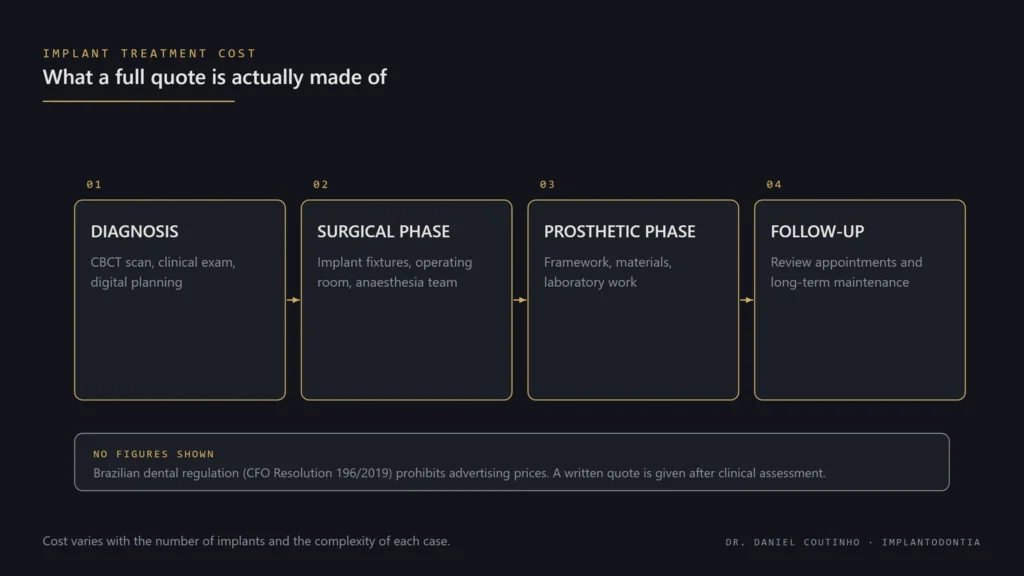
Before comparing proposals, ask exactly what is covered. A plan that looks unusually simple often omits a step that only becomes visible once treatment has already started. Ask whether the plan includes:
- the imaging exams used for planning
- the surgical procedure itself
- the implant fixture and the abutment
- the temporary prosthesis, if one is used during healing
- the final crown or prosthesis
- follow-up appointments and any adjustment visits
- what happens, and who pays, if a stage needs to be repeated
The last item is the one people forget to ask about, and it is the one that matters most when you live in another country.
Planning the trip: how many visits, and how long
Implant treatment is staged around biology, not around travel convenience. Bone needs time to integrate with the implant surface, and that period is measured in months, not days. In practice this means most complete cases involve more than one trip, and the interval between them is set by healing, not by scheduling.
Some approaches allow a provisional fixed prosthesis to be placed shortly after surgery, so a patient does not go home without teeth, with the definitive prosthesis made at a later stage. Whether that applies depends on bone quality and on how the implants perform at the moment of placement — it is assessed during surgery, not promised beforehand.
When you weigh treatment in Brazil against treatment at home, include flights, accommodation, and the number of trips in the picture. The clinical plan on its own is not the whole undertaking, and any comparison only works when both sides account for everything.
How to verify a dentist in Brazil
Every dentist practising legally in Brazil is registered with a state council, the Conselho Regional de Odontologia, and carries a CRO number tied to that state. The number is public and can be checked against the council register before you commit to anything. Ask for it in writing, together with the full name and the address of the clinic.
It is also reasonable to ask who performs the surgery, whether that is the same person you have been corresponding with, and who is responsible for follow-up after you return home. Clear answers to those three questions tell you more than any brochure.
Why patients travel to Brazil for implant treatment
Brazil has a large and long-established implant dentistry sector, with clinicians trained in techniques used worldwide, including complex rehabilitations in patients with severe bone loss. For someone who has been told at home that they do not have enough bone, that matters: cases that would otherwise require extensive grafting are sometimes approached differently, evaluated individually.
Natal, in the northeast, is served by an international airport and is a practical base for a treatment trip. None of this replaces a clinical assessment — it only explains why the option is worth evaluating rather than dismissing.
How treatment works with Dr. Daniel Coutinho
Every plan starts with a clinical evaluation and imaging exams, conducted personally by Dr. Daniel Coutinho (CRO-RN 2966), in Natal, Brazil. Only after that evaluation is a real, case-specific estimate possible — because the exam is what defines the actual scope of treatment.
For patients abroad, an initial remote conversation can establish whether the case is worth pursuing and what exams would be needed, before anyone books a flight. It does not replace the in-person evaluation, and no plan is finalised without it.
How the plan is presented
Practical arrangements are discussed once the treatment plan is defined, since the scope is what determines everything downstream. It is reasonable to raise the subject during the same visit as your clinical evaluation, when the plan is already on the table and the conversation can be concrete.
Can I get a complete plan before traveling to Brazil?
A definitive plan requires imaging exams and a clinical evaluation, since treatment scope varies by case.
What if I don’t have enough bone for a standard dental implant?
Techniques such as zygomatic implants can be an option for patients with severe bone loss, evaluated individually.
Scope is one of the two questions patients weigh. The other is whether Brazil is safe for dental implants. For the wider picture of dental implants in Brazil, and why patients travel for them, start here.
Schedule your evaluation in Natal, Brazil
The plan changes when there is not enough bone to place standard implants. The page on zygomatic implants in Brazil covers what the treatment involves when bone grafting is not the chosen path.
The plan is only one part of the decision. The practical side — number of stays, timeline and follow-up — is set out in how treatment works when you come from another country.
Every case has particularities that only a clinical exam and a CT scan can reveal. If you would like to understand the options for your situation, the first step is an assessment with Dr. Daniel Coutinho (CRO-RN 2966), in Natal, Brazil. That page sets out exactly what to send, and why no honest figure can be given before it is seen.
Cartas do Dr. Daniel Coutinho. Uma carta a cada 15 dias com um assunto como este, explicado com calma. Sem propaganda; para sair, é só responder SAIR.
[…] offered without imaging should be treated with caution. For background on what shapes the plan, see what determines the treatment plan in Brazil, and for why patients travel in the first place, why foreign patients cross […]