
Quick answer: Zygomatic implants are anchored in the cheekbone (the zygomatic bone) instead of the upper jaw. Because the cheekbone barely resorbs after tooth loss, it can support a fixed prosthesis even when the upper jaw no longer has enough bone for conventional implants — which is why the technique often avoids the bone grafting patients are usually told they need first.
What a zygomatic implant actually is
A conventional implant is fixed into the maxilla, the bone of the upper jaw. That bone resorbs after teeth are lost, and it keeps resorbing for years — which is why a patient who has worn a full denture for a long time is often told there is “not enough bone”.
A zygomatic implant is different. It is a longer implant anchored in the zygomatic bone, the dense structure that forms the cheekbone. That bone does not resorb the way the jaw does. It stays essentially intact even in patients who have been without teeth for many years.
That single anatomical fact is the whole point of the technique: it moves the anchorage to bone that is still there.
Who is a candidate
- Severe bone atrophy in the upper jaw
- Long-term full-denture wearers who have lost bone volume
- Cases where conventional bone grafting would be extensive, slow, or of uncertain outcome
- Patients who have already been told at another clinic that they “have no bone” for implants
- Reconstruction after maxillofacial cancer treatment
Candidacy is confirmed only after clinical examination and imaging. Every case has a different bone anatomy, and no honest answer to “am I a candidate” exists before a CT scan has been read.
If you were told you need a bone graft first
This is the situation that brings most international patients to the question. A graft means a second surgical site, months of healing before the implants can even be placed, and an outcome that is not guaranteed in severely atrophic cases.
Zygomatic anchorage avoids that step in most cases. It does not make grafting wrong — it makes it unnecessary for a specific group of patients. Which group you belong to is a diagnostic question, not a commercial one.
What the evidence shows
Zygomatic implants are not a new or experimental technique. They have decades of clinical literature behind them.
The largest systematic review to date pooled 4,556 zygomatic implants placed in 2,161 patients and reported a 12-year cumulative survival rate of 95.21%. Most failures occurred early, within the first six months after surgery (Chrcanovic, Albrektsson & Wennerberg, J Oral Maxillofac Surg, 2016).
The same review quantified the complications rather than leaving them vague: sinusitis 2.4%, soft tissue infection 2.0%, paresthesia 1.0%, oroantral fistula 0.4%. Sinusitis is the most frequent, and it can appear years after the surgery — which is one reason follow-up matters as much as the operation.
An earlier systematic review by the same lead author reported a 12-year cumulative survival of 96.7% across 42 studies (Chrcanovic & Abreu, Oral Maxillofac Surg, 2012). That review also stated plainly what any honest page should repeat: placing zygomatic implants requires very experienced surgeons, because delicate anatomical structures are involved.
None of this makes the procedure routine. It makes it predictable in trained hands — which is a different claim, and the honest one.
How treatment works
- Imaging and planning. A CT scan maps the zygomatic anatomy and the exact trajectory for each implant. Nothing is decided before this exists.
- Surgery. Titanium implants are anchored in the zygomatic bone, under sedation, in a facility prepared for the procedure. Four implants per arch.
- Fixed provisional prosthesis. In many protocols a fixed temporary prosthesis is placed within a few days, so the patient leaves with function and appearance restored rather than with a healing period spent toothless.
Recovery
Swelling and discomfort in the first days are expected, as after any surgery, and are managed with prescribed medication. Most patients move to a soft diet within the first week and progress from there, following the surgeon’s guidance.
Close follow-up in the first weeks is what allows a problem to be caught early. For a patient who is travelling, this is the part of the plan that has to be discussed before the flight is booked — not after.
Before you book a flight
A remote conversation cannot replace an in-person examination, but it can establish whether the case is worth pursuing at all and which images would be needed. What to ask any clinic, here or anywhere:
- Who performs the surgery, and what is their professional registration
- Whether a CT scan will be read before any plan is offered
- What happens if a complication appears after you fly home
- Whether the quote includes the prosthesis, not only the implants
A clinic that accepts every case without conditions is not being accommodating. It is skipping the diagnosis.
Two related questions usually come next: whether Brazil is safe for dental implants and what determines the treatment plan in Brazil. For the wider picture of dental implants in Brazil, and why patients travel for them, start there.
Frequently asked questions
Can I have implants if I was told I have no bone?
Often yes. “No bone” almost always refers to the upper jaw. The zygomatic bone is a different structure and is usually preserved. Only imaging can confirm it in your case.
Do zygomatic implants avoid bone grafting?
In most indicated cases, yes — that is the main reason the technique exists.
Is there scientific support for the technique?
Yes. It has decades of literature and clinical follow-up and is recognised as an option for rehabilitating the upper jaw with pronounced bone loss. Indication is always individual and based on examination.
Are there age limits?
Age alone does not contraindicate the surgery. What defines safety is risk assessment, not the number of years.
Is a zygomatic implant the same as a full-arch protocol?
They are related concepts but not synonyms. The prosthesis may look similar; the anchorage is not. For the practical side of travelling for treatment — assessment, number of stays and follow-up once you are home — see how dental tourism in Brazil actually works.
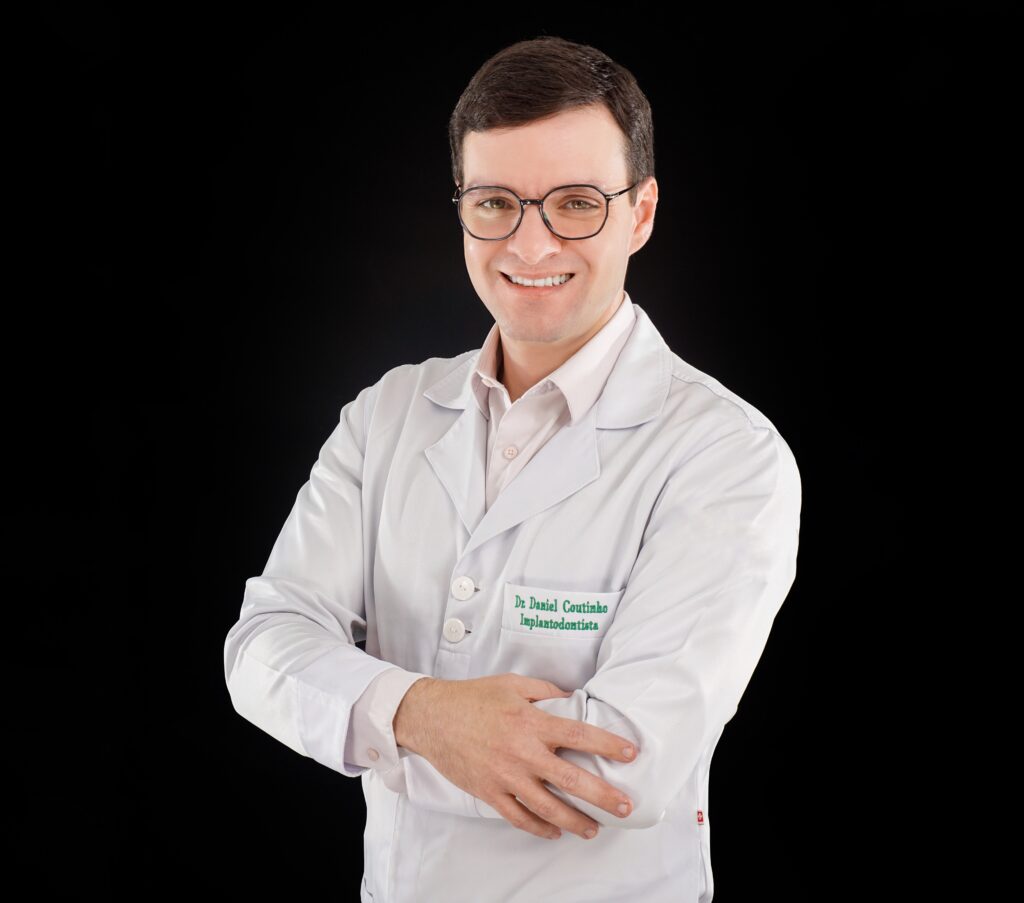
Talk to Dr. Daniel Coutinho
Evaluations are carried out personally by Dr. Daniel Coutinho, CRO-RN 2966, specialist in Implantology (FOP-UNICAMP), in Natal, Rio Grande do Norte, Brazil.
Whether this applies to you is decided by imaging, not by a web page. See what to send for a preliminary opinion — a CT scan and a short history are enough to get a useful answer, and you will be told when the case is not one for zygomatic implants.
Before travelling anywhere for surgery, it is worth checking who would operate: Dr. Daniel Coutinho’s credentials, and how to verify a Brazilian dentist’s registration yourself.
Cartas do Dr. Daniel Coutinho. Uma carta a cada 15 dias com um assunto como este, explicado com calma. Sem propaganda; para sair, é só responder SAIR.
[…] Zygomatic implants in Brazil […]
[…] Zygomatic implants in Brazil […]