

Most articles about dental tourism in Brazil are written to sell a package. This one is written to explain a process. If you are considering dental treatment abroad, what you actually need to know is not a headline number — it is how the treatment is sequenced, how long you have to stay, what happens when you fly home, and how to verify who will be operating on you.
Resposta rápida: Dental treatment in Brazil usually begins with a remote assessment based on a CT scan, not with a quote. Most full-arch cases require two stays: one for surgery and immediate loading, another for the definitive prosthesis, several months apart. What determines whether a case is feasible is bone volume, which is why no responsible treatment plan is issued before imaging.
How dental tourism in Brazil actually works, step by step
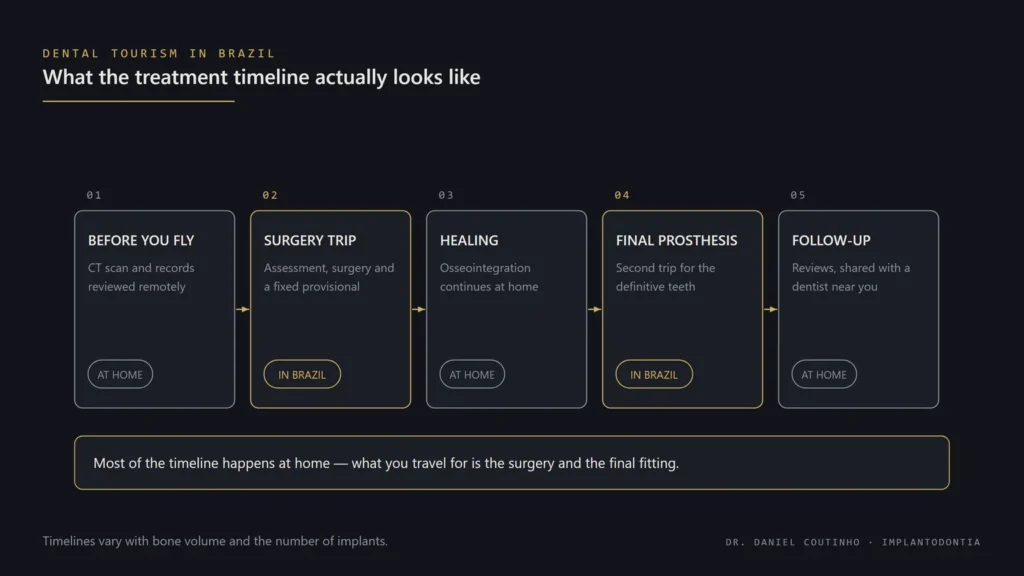
The sequence below is what a well-organised case looks like. If any of these steps is missing from what you are offered, that absence is itself information.
- 1. Remote assessment. You send existing records and, ideally, a cone beam CT scan. A panoramic radiograph is not enough to plan implants: it is a two-dimensional image and cannot show bone width or the position of anatomical structures.
- 2. Preliminary plan and feasibility. At this stage the surgeon can say whether the case is viable, which technique applies and how many stays it will require. What cannot responsibly be given remotely is a definitive plan — the clinical examination may change it.
- 3. First stay: examination, surgery and immediate loading. In most full-arch cases a fixed provisional prosthesis is installed during this stay, so you do not travel home without teeth.
- 4. Healing period at home. Osseointegration takes months. This is spent in your own country, with remote follow-up.
- 5. Second stay: definitive prosthesis. Impressions, try-ins and installation of the final work.
- 6. Long-term maintenance. This is the step almost every dental tourism article omits, and it matters more than anything else for the outcome.
How long you actually need to stay
This is the question most often answered vaguely. The honest answer is that it depends on the technique and on the case, and that it is normally split across two trips rather than one. Planning a single short trip for a complete rehabilitation is the most common source of frustration in dental tourism in Brazil — not because the treatment fails, but because the expectation was built on a timeline that does not exist.
Ask, before booking flights, for the expected number of days on the ground for each stay and the expected interval between them. A clinic that has planned your case can answer that.
What happens when you go home
Follow-up is the weakest point of treatment abroad, and it is worth addressing directly before you commit. Establish who you contact if something feels wrong, how remote review is done, what the plan is if an adjustment is needed, and what the arrangement is should a complication arise after you return. These are reasonable questions and any serious clinic will have answers.
It is also worth arranging local support at home for routine maintenance — hygiene appointments and periodic review do not require the original surgeon and should not be postponed until your next flight.
What to verify about the surgeon
In Brazil, dentistry is a regulated profession and every practising dentist holds a registration number with a Regional Council of Dentistry, the CRO. Specialists in implantology hold a separate registered qualification. This is public information and it is verifiable before you travel. The topic is covered in detail in Is Brazil Safe for Dental Implants?.
One distinction worth making: many websites that appear when you search for dental tourism in Brazil are not clinics. They are agencies and marketplaces that route patients to partner clinics. There is nothing inherently wrong with that model, but you should know which one you are talking to, and whether the person answering your questions is the person who will perform the surgery.
When bone volume changes the plan
The single most common reason an international case turns out differently from what the patient expected is bone. Long-term denture use and advanced bone loss in the upper jaw can rule out conventional implants. That does not necessarily mean grafting and a much longer timeline: anchorage in the cheekbone is an established alternative, with a cumulative survival rate of 95.21% over 12 years across 4,556 implants in 2,161 patients (Chrcanovic et al., J Oral Maxillofac Surg, 2016). It is described in Zygomatic Implants in Brazil.
This is precisely why the CT scan comes before the plan, and why a plan offered without imaging should be treated with caution. For background on what shapes the plan, see what determines the treatment plan in Brazil, and for why patients travel in the first place, why foreign patients cross borders.
Key points
- Treatment normally starts with a CT-based remote assessment, not with a quote.
- Full-arch rehabilitation usually requires two stays, months apart, not a single trip.
- A fixed provisional prosthesis is commonly installed during the first stay.
- Follow-up arrangements should be agreed before you travel, not after.
- Every Brazilian dentist holds a verifiable CRO registration number.
- Bone volume is what determines feasibility, which is why imaging precedes planning.
How does dental tourism in Brazil work?
It typically starts with a remote assessment based on a CT scan, followed by a first stay for examination, surgery and immediate loading with a provisional prosthesis, a healing period at home, and a second stay for the definitive prosthesis.
How long do I need to stay in Brazil for dental implants?
It depends on the technique and the case, and it is normally split across two trips rather than one. The expected number of days for each stay and the interval between them should be given to you before you book flights.
Can I get a treatment plan before I travel?
A preliminary plan and a feasibility opinion can be given remotely if you provide a cone beam CT scan. A definitive plan requires clinical examination, because the examination may change it.
What happens if there is a problem after I return home?
This should be agreed before treatment begins: who you contact, how remote review is carried out, and what the arrangement is if an adjustment or intervention is needed. Arranging local support for routine maintenance is also advisable.
How do I check that a Brazilian dentist is qualified?
Every practising dentist in Brazil holds a registration number with a Regional Council of Dentistry, known as the CRO, and specialists hold a separately registered qualification. This information is public and verifiable before you travel.
What if I have been told I do not have enough bone?
Advanced bone loss in the upper jaw does not necessarily require grafting. Anchorage in the cheekbone, known as zygomatic implantation, is an established alternative. Only a CT scan can establish which applies to your case.
More for international patients
Planning treatment abroad involves more than the trip itself. Dental implants in Brazil covers what shapes the plan, and is Brazil safe for dental implants? addresses the question most patients ask first.
Schedule your evaluation in Natal, Brazil
Every case has particularities that only a clinical examination and a CT scan can reveal, and that is as true from abroad as it is locally. If you would like to understand which options apply to your situation, the first step is an assessment with Dr. Daniel Coutinho (CRO-RN 2966), in Natal, Brazil. You can book online or message Carolina on WhatsApp.
Cartas do Dr. Daniel Coutinho. Uma carta a cada 15 dias com um assunto como este, explicado com calma. Sem propaganda; para sair, é só responder SAIR.
[…] is one question; logistics is another. See how dental tourism in Brazil actually works — remote assessment, number of stays and […]